

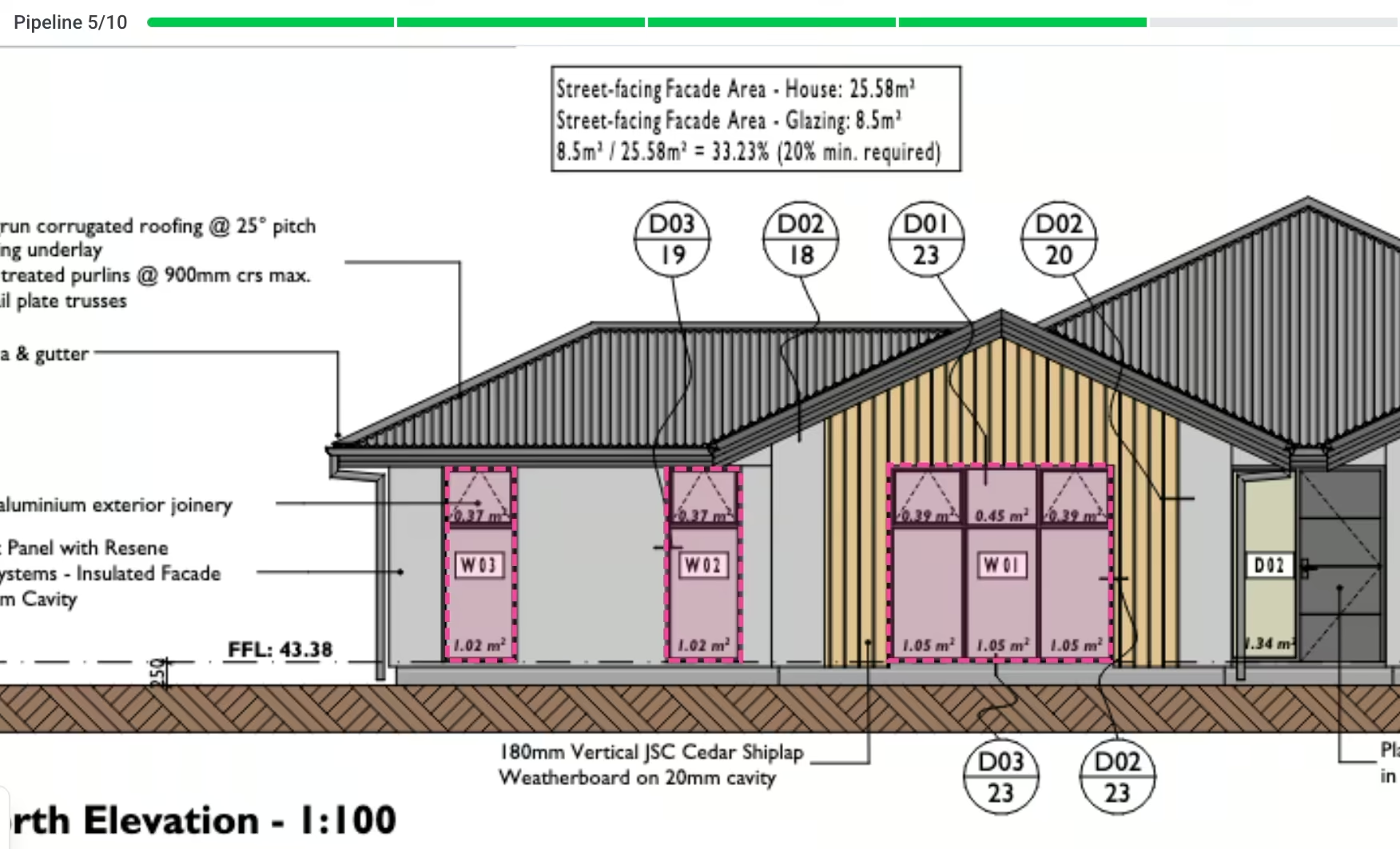
When people hear “AI takeoffs,” the first question is often: “How accurate is it?” It’s a reasonable question, but there’s more to unpack here.
In residential construction estimating, you need speed to respond while jobs are still winnable, control so you can stand behind your quantities, and accountability so responsibility stays with the qualified professional.
The better question is: “Can this system produce a fast first draft that I can verify, price and confidently export?”
There’s a fundamental difference between automation that replaces judgement and assistance that removes tracing work.
Accuracy is a workflow
Takeoffs fail when the scale is wrong, when someone measures an outdated plan revision, when a symbol gets misinterpreted, or when a detail is missed or double-counted. These are workflow problems, not model problems.
Chasing a single accuracy percentage misses the real opportunity: reduce time-to-first-draft dramatically, then make verification fast and explicit. That’s how you move quicker and stay safe.
Verified exportable quantities & prices, fast
Estimators and QS professionals get paid for judgement: deciding what matters, catching what’s missing, understanding scope boundaries, and producing quantities the business can act on.
The bottleneck is the manual drafting and tracing time that delays that judgement.
A good system produces a first-pass draft quickly so you’re not starting from zero, makes verification mandatory and straightforward so you keep control, and exports cleanly into existing workflows so it actually creates value.
The real metrics to track
If you want to evaluate AI takeoffs the way an estimating team experiences them, measure outcomes that map to throughput and accountability:
- Time to first draft: how long from upload to a usable first-pass takeoff.
- Time to verified, exportable quantities: how long from first draft to “approved” and ready to export.
- Verification effort: how much human time it takes to review and correct (the goal is to make this fast and explicit).
- Edit rate (a healthy signal): if users are verifying and editing, the workflow is working. Zero edits can mean either perfection or blind trust.
- Export rate: drafts that never get exported aren’t value, just previews.
What “human-in-the-loop” actually means
“Human-in-the-loop” often gets used as vague reassurance. For takeoffs, it should mean something specific:
- The output is explicitly a draft. Not a certification, compliance statement, or something you blindly accept.
- The user must verify. The qualified professional confirms scale, reviews detections, and edits anything needed.
- The user stays responsible. The workflow keeps accountability with the estimator or QS, not with the software.
TakeoffQS is built around this pattern: fast first-pass takeoffs for supported residential scopes, followed by required verification, then export to CSV / Excel. We’re explicit about what we provide (draft takeoffs for supported scopes) and what we don’t: engineering certification, compliance statements, or bracing calculations.
Conclusion
The point isn’t to pretend estimating can be automated end-to-end. It can’t. Not safely, not consistently, and not in a way a professional can stand behind.
What does work is a workflow where AI removes the slowest, most repetitive part (first-pass measurement), and the estimator keeps the part that actually matters: confirming scale, reviewing what’s been detected, correcting edge cases, and owning the final export.